
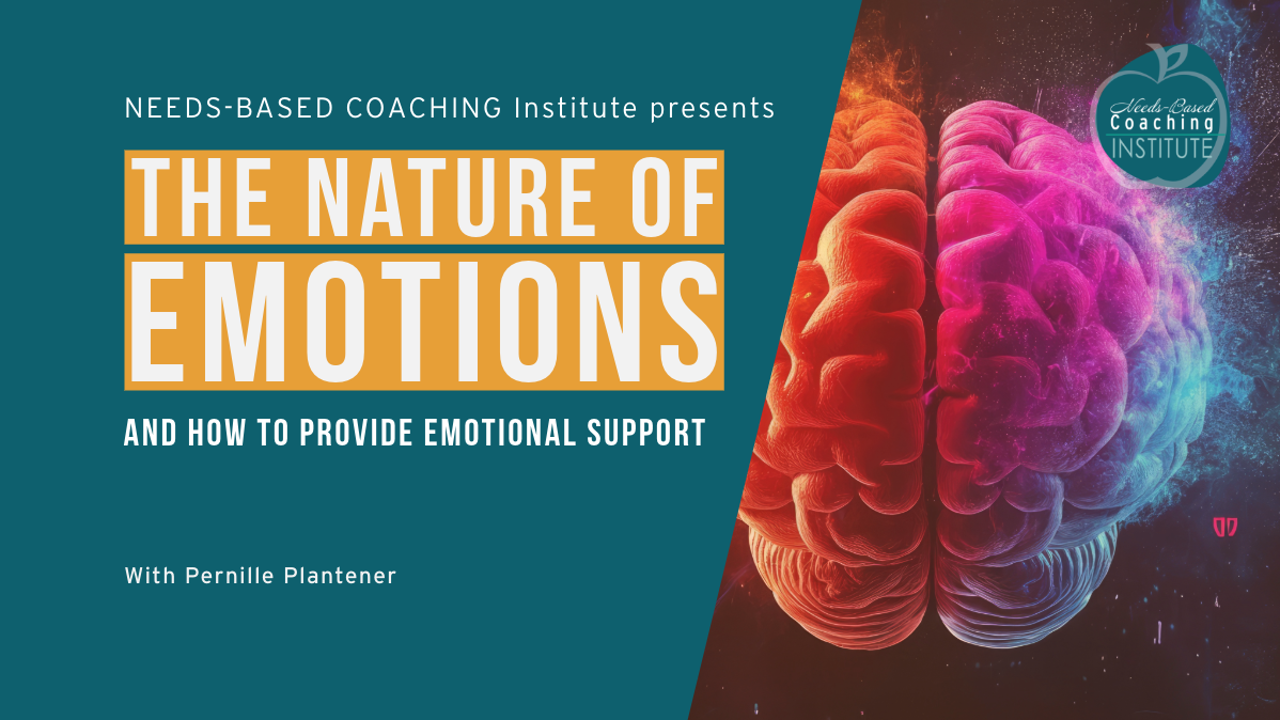
The nature of emotions - and how to be an emotion-wise coach
From Nonviolent Communication (NVC), we know that emotions are messengers from our inner system about the state of our needs. Are we safe? If not, we feel a degree of fear.
But emotions are not just messengers; they offer the felt sense of being alive. Some people experience emotions as bright, others as pastel colors, or some emotions only vaguely. How can it be so? How can an emotion-wise coach support clients to notice and get to terms with their feelings? What does it mean for YOU if you expand your window of welcome for emotions?

Brain awareness in coaching
Did you know that your brain has a left and right hemisphere? They offer us two different perspectives on the world and ourselves. Brain awareness can make a huge impact on your coaching practice. Our right hemisphere is the primary centre of our relational perspective. This is the seat of empathy, the home of our emotions, while the left hemisphere hosts our instrumental view and understanding. This is where we get things done.

Metaphors as a shortcut to aliveness
Why don’t you allow yourself to broaden your skills to connect? There are many ways to create an empathic space, inquiring about feelings and needs only being one of them. I want to introduce you to a playful, creative skill that engages the right brain hemisphere of the person you are sitting with. The right hemisphere or the relational brain is where the client can connect with what is alive in them.

Teaching and giving advice vs coaching
Isn’t it so easy to know? To see what’s going on. To look at your client and think: “You need this piece of information!” But this is not what your client came for. Certainly not in Needs-Based Coaching. They didn’t book a session to get advice unless they really ask for this. They come to experience themselves, to connect with themselves, and not to walk away with a bag full of homework.

AI and coaching (and Needs-Based Coaching)
Artificial Intelligence (AI) has entered the stage and will increasingly permeate our lives.
It is not in my power to oppose its advance. And, as a coach, I’m very curious to explore where and when it’s time to draw a line, and where I’d enjoy welcoming and recommending it.

The difference between coaching and psychotherapy
What is the difference between Coaching and Psychotherapy? This is a question that always comes up during our coach education. There is no unambiguous distinction between the two. Although historically, there was. Let’s have a closer look.